Written by Chloe Melka, LPCC, trauma-informed therapist
There’s no bruise. There’s no single fight you could describe to a friend and have them say, “Wow, that’s not okay.” But something feels wrong. You’ve started editing what you say, tracking someone’s mood before your own, and wondering whether you’re the problem.
If that’s you, I want to say this first: you don’t have to justify your pain. And you don’t need a dramatic moment to deserve support.
Emotional abuse is a pattern of behavior that controls, shames, or frightens you. It’s about power, not love or concern. When these patterns add up, it’s often called coercive control, and it can be deeply damaging even when there’s never any physical violence. There’s no official list of seven, but these are seven of the most common patterns I see. A hurtful argument or a bad week isn’t automatically abuse. What matters is the pattern, and whether you still feel free to be yourself and safe in the relationship.
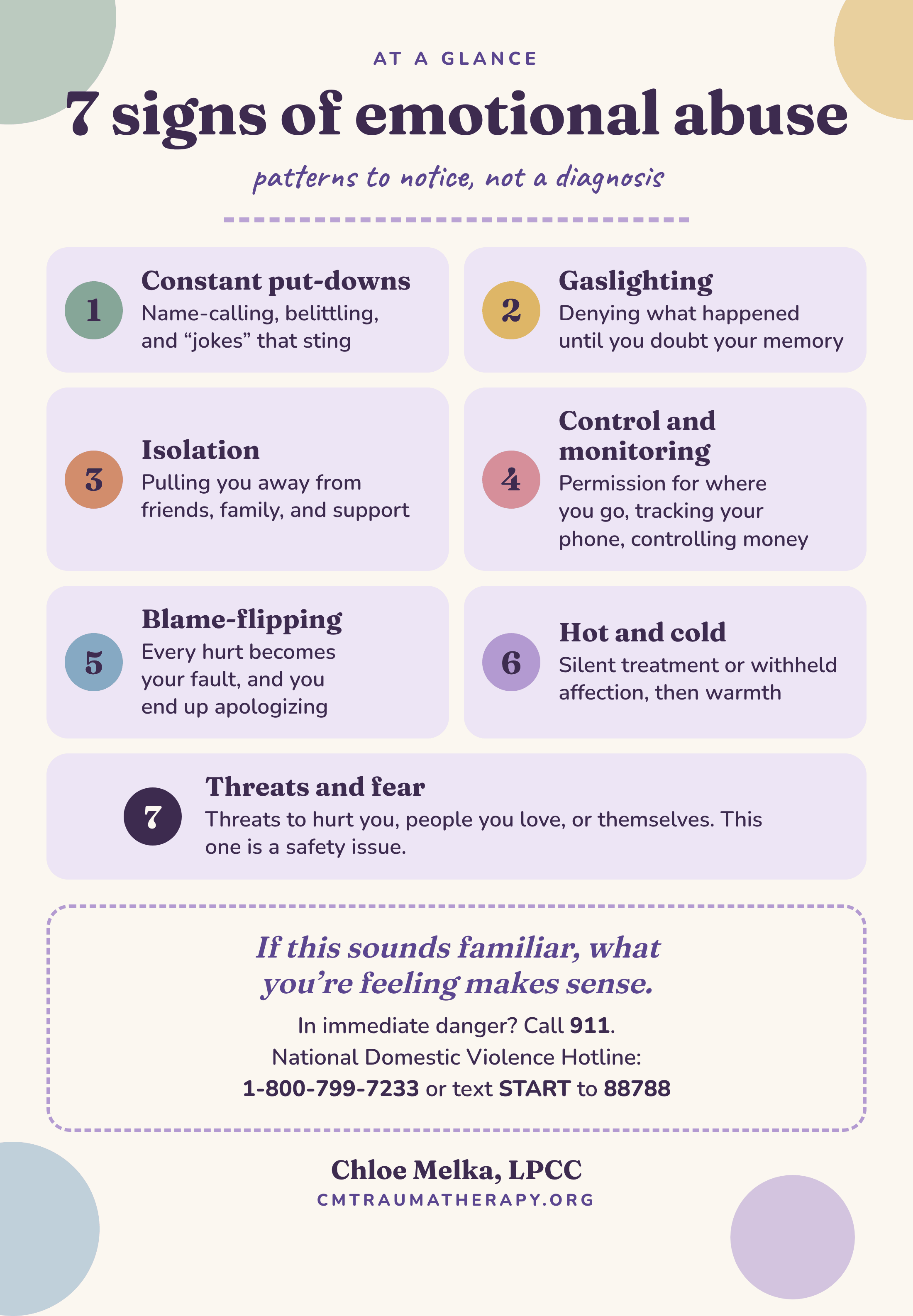
1. Constant put-downs
It might be name-calling. It might be a “joke” about how you look, how you parent, or how you cook, followed by “Relax, I’m kidding.” Over time you start finishing the criticism in your own head before they can.
2. Gaslighting
You remember exactly what they said. They tell you it never happened, or it wasn’t that bad, or you’re too sensitive. It usually builds slowly, one small denial at a time, until you stop trusting your own memory. If it’s safe, keeping private notes somewhere only you can access can help you hold on to your own reality.
3. Isolation
They sulk when you see friends. They find something wrong with each of your people. Slowly the circle gets smaller, until they’re your only support. That’s not an accident. The fewer people you have, the more power they have.
4. Control and monitoring
This can look like needing permission for where you go, who you see, or what you wear. It can mean checking your phone, tracking your location, demanding an instant reply to every message, or controlling the money. Picture your stomach dropping when a text goes unanswered for ten minutes, not because you did anything wrong, but because of what you know comes next.
5. Blame-flipping
You bring up something that hurt you, and somehow you end the conversation apologizing. Sometimes it goes further: they deny it, attack you, and cast themselves as the wronged one. (This pattern even has a name, DARVO, short for deny, attack, and reverse victim and offender.) If you often leave a conversation more confused and more sorry than when you started, notice that.
6. Hot and cold
The silent treatment. Affection that disappears when you “misbehave.” Then warmth, attention, and sometimes big gestures when the tension has done its work. Because the relief after the distance feels so good, it can bond you tighter, which is sometimes called trauma bonding. It’s one reason these relationships are so hard to leave. If this one feels familiar, you might also like my post Why Do I Keep Choosing Partners Who Hurt Me?.
7. Threats and fear
Threats to hurt you, someone you love, a pet, or themselves if you leave. Using the kids as leverage. Living in a state of walking on eggshells. This one is a safety issue, not just a pattern to work on. If someone threatens self-harm, take it seriously, but remember you’re not responsible for their actions. The hotline below and the 988 Suicide and Crisis Lifeline can help you think it through.
What this does to you
Being treated this way can show up as anxiety, low mood, trouble sleeping, or doubting yourself in ways you never used to. These are common responses to a painful environment, not signs that something is wrong with you. If you’d like to read more about how I support these symptoms, you can find it on my Anxiety & Depression page.
If this sounds familiar
You don’t have to figure it all out today. A small step, taken with support, counts.
Trust that what you’re noticing is real. You don’t need proof or a perfect label to deserve help.
Talk to someone outside the relationship. A trusted friend, an advocate, or a therapist can help you see the pattern from the outside.
Think about safety first. If you believe your phone, email, or location may be monitored, use a device and account they can’t access when you reach out for help.
Call or text an advocate. The National Domestic Violence Hotline can talk through what you’re experiencing and help with safety planning, even if you’re not sure it counts as abuse.
If you’re in immediate danger, call 911. The National Domestic Violence Hotline is 1-800-799-7233 (or text START to 88788).
Healing after emotional abuse
If you’ve left an emotionally abusive relationship, or you’re out and still carrying it, I’d be glad to talk. I offer online trauma therapy for women across California, with a focus on domestic violence and relationship trauma, and you can book a free consultation. If you’d like a gentle structure to work through at your own pace, my 8-week workbook, Safe to Love Again, is made for that stage.
If you’re still in the relationship, please start with the hotline or a local advocate. They can help you plan for your safety, and therapy can come when it’s safe.
This post is for education only and isn’t a substitute for therapy. If you’re in crisis, call or text 988.