Written by Chloe Melka, LPCC, trauma-informed therapist
Break cycles of attraction to toxic relationships
You meet someone and it feels electric. Three months later you notice the familiar signs: the mood swings, the guilt trips, the way you’ve started editing yourself to keep the peace. And a tired little voice in your head asks, How did I end up here again?
If that’s you, I want to say a few things before anything else. You are not foolish. You are not broken. And it is never your fault that someone hurt you. What you’re noticing is a pattern, and patterns have reasons. The good news is that once you understand the reasons, you have something you can actually work with.
Quick answer: Why do I keep choosing partners who hurt me?
Repeatedly choosing partners who hurt or neglect you is rarely a sign of poor judgment. It is usually a learned response to earlier relationship experiences and trauma. The most common reasons are:
Familiarity feels like chemistry. After trauma, your nervous system can mistake anxiety and unpredictability for attraction.
Early lessons about love. If love once meant walking on eggshells or earning affection, that pattern can feel "normal" (this is sometimes called trauma reenactment or repetition compulsion).
Insecure attachment and fawning. Learning to please and keep the peace can make boundary-crossing partners harder to spot and harder to leave.
An alarm system that misfires. Trauma can make you hypervigilant to some cues and numb to others, so real red flags get explained away.
These patterns can change with understanding, practice, and support.
Why Does Familiar Feel Like Chemistry After Trauma?
If you grew up around unpredictability, or your last relationship ran hot and cold, your nervous system may have learned a confusing equation: anxiety plus longing equals attraction.
Picture a partner who is wonderful on Monday, distant on Tuesday, and deeply apologetic on Wednesday. Your body spends the whole week trying to guess which version is coming. That guessing game keeps you hooked, because rewards that arrive unpredictably tend to grab us harder than rewards that arrive reliably.
Intermittent reinforcement: a pattern in which rewards (affection, attention, apologies) arrive unpredictably, which makes the bond harder to break. It is one reason these relationships are so hard to leave. It’s biology, not weakness.
Trauma bonding: a strong emotional attachment that forms through a repeating cycle of mistreatment, intermittent reinforcement, and relief or reconciliation.
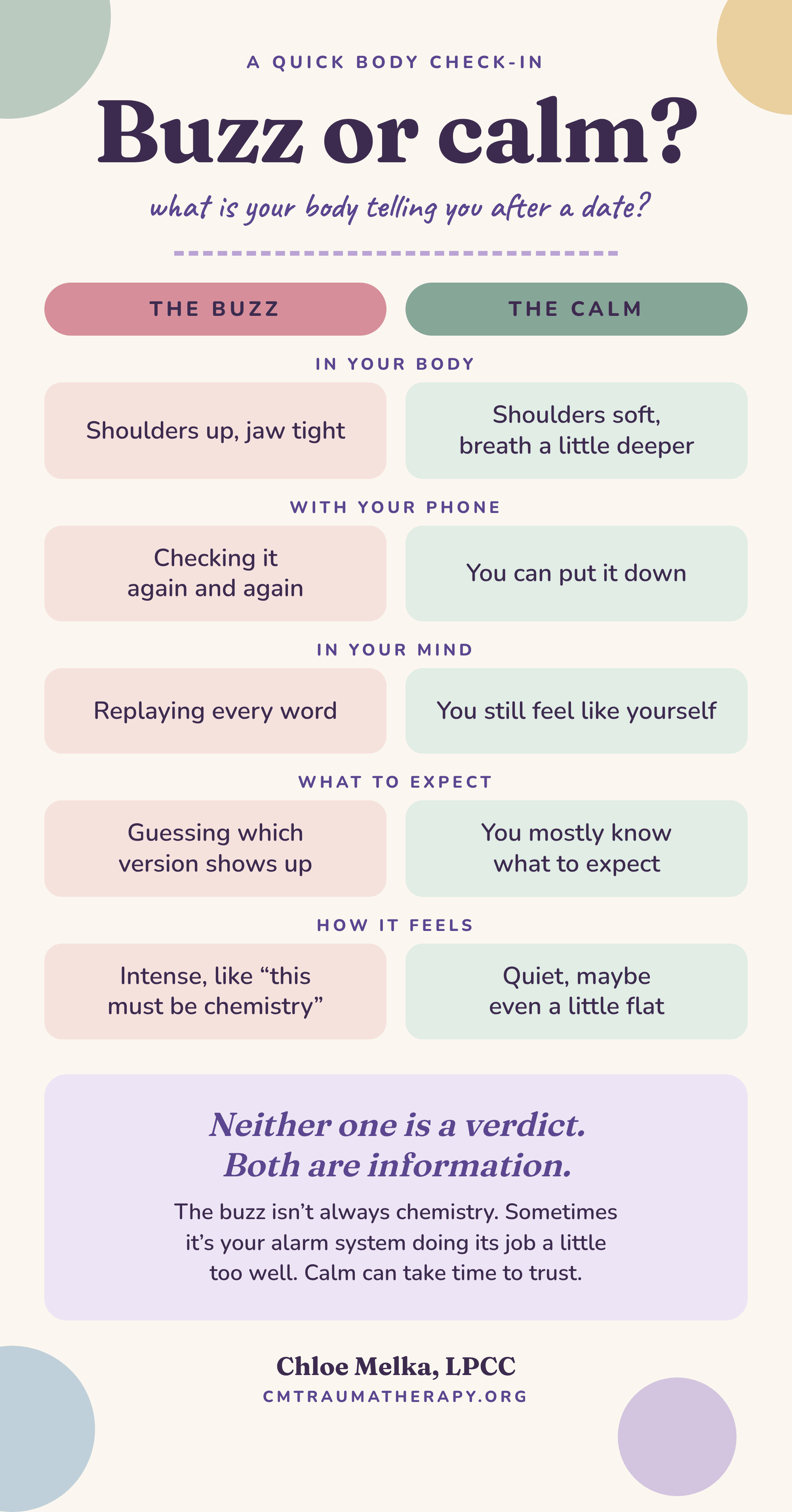
Now picture someone steady and kind. They text when they say they will. They remember what you told them last week. And you feel... nothing. Maybe even a little bored. I hear this from clients constantly, usually followed by “so there must be something wrong with me.” There isn’t. Your body may simply not have learned what safe feels like yet. That buzz you feel isn’t always chemistry. Sometimes it’s your alarm system doing its job a little too well, and calm can take a while to trust.
How Do Early Relationships Shape Who You’re Drawn To?
We pick up our first lessons about love long before we’re old enough to question them. If love meant walking on eggshells, managing someone’s moods, or earning affection by being useful, then those things can feel like “normal” later on. Normal and healthy are not the same, but they sure can feel identical.
Repetition compulsion (trauma reenactment): the unconscious pull to recreate familiar relational dynamics from the past, sometimes in an effort to finally get a different outcome.
Survival strategies matter here too. If you learned to keep the peace by pleasing, over-apologizing, or staying small (some therapists call this fawning), that was smart protection at the time. The catch is that it can make you the easiest person in the world for a controlling partner to be around, because you rarely push back. That isn’t a flaw in you. It’s a skill your body built to keep you safe, and skills can be updated. That isn’t a flaw in you. It’s a skill your body built to keep you safe, and skills can be updated. That same protection can also make it hard to let a safe person in, which I explore in why you can’t open up to your partner about your past.
Earned secure attachment: the shift from an insecure attachment style toward a more secure one through new relationship experiences, boundary practice, and healing work, often with the support of therapy.
Why Do I Ignore Red Flags, and Then Blame Myself?
After trauma, your body’s alarm system gets extra sensitive, like a smoke detector that shrieks at burnt toast. Here’s the plot twist: it can also go quiet when it should be loud. Red flags get explained away. He’s just stressed. She didn’t mean it. I’m probably overreacting.
Then comes the hindsight voice: I should have seen the signs. I say this with a lot of care: knowing what you know now isn’t proof you should have known it then. Manipulation works by hiding the truth from you.
That’s why I teach clients to separate a trigger from a truth. A trigger is sudden, intense, and tied to a reminder of the past. A red flag is something you can actually observe, it repeats, and it’s still there after you’ve grounded yourself. The goal isn’t to stop feeling alarmed. It’s to pause, then check the facts.
How Can You Break the Cycle of Choosing Hurtful Partners? 5 Small Steps
You don’t need to overhaul your whole love life by Friday. Pick one or two of these and go at your own pace.
Slow the pace. Give your nervous system time to gather real evidence about someone. Intensity isn’t the same as intimacy, and anyone who pushes past your “not yet” has told you something. Intensity isn’t the same as intimacy, and anyone who pushes past your “not yet” has told you something. If you’re wondering what a slower start actually looks like, I walk through it in how to date again after serious relationship trauma.
Check buzz versus calm. After you spend time with someone, check in with your body. Are your shoulders up around your ears and your phone-checking frantic? Or do you feel steady and like yourself? Neither is a verdict, but both are information.
Watch behavior, not promises. Do their actions match their words? Pay close attention to how they respond to a small boundary like “I can’t tonight, but I’d like Thursday.” A healthy person may feel disappointed, and that’s human, but they respect your answer.
Practice a tiny no. Start low-stakes. “Let me think about it” instead of an automatic yes counts. Boundaries are a muscle, and nobody walks into the gym and deadlifts on day one.
Bring someone safe in. Tell a trusted friend or your therapist what you’re noticing. Patterns are much easier to see from the outside.
If you’d like a structure for this, my 8-week workbook, Safe to Love Again, walks through each of these skills step by step, including a five-question check for telling a trigger from a truth.
When Should You Get Trauma Therapy for Relationship Patterns?
Self-guided tools can help, but some situations call for a trained guide beside you. Please consider working with a therapist if you have a history of relationship trauma or sexual trauma that still affects your daily life, if you notice flashbacks or feeling numb or far away, or if you keep landing in the same painful dynamic despite your best efforts. Needing support is wise, not weak.
And if you’re in a relationship where you feel afraid, controlled, or unsafe, that’s a safety issue, not a pattern to work on. You can reach the National Domestic Violence Hotline at 1-800-799-7233 (or text START to 88788), or call 911 if you’re in immediate danger. You can also read more about my work with domestic violence survivors.
You Set the Pace
Healing isn’t a straight line. It’s more like a spiral staircase: you pass the same view again, from higher up. Slow is allowed. Repeating a step is allowed. And you don’t have to do this alone.
If you’re ready to talk, I offer online trauma therapy for women across California, and I’d be glad to meet you for a free consultation. No pressure, just a conversation about what’s been happening and whether we’re a good fit. Fair warning: my dog, Kona, may make a cameo on screen.
About the author: Chloe Melka, LPCC, is a trauma-informed therapist specializing in relationship trauma and the author of the 8-week workbook Safe to Love Again. She offers online therapy for women across California at cmtraumatherapy.org.
This post is for education only and isn’t a substitute for therapy. If you’re in crisis, call or text 988.